CARLO PENSA WILL BE A SHINING LIGHT
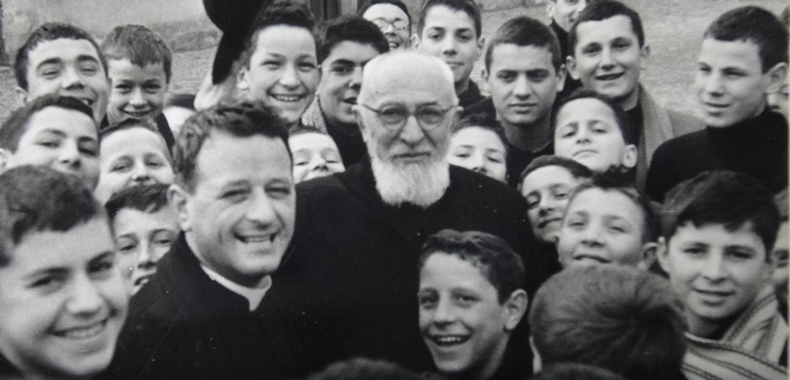
A brief biographical and spiritual presentation of Fr. Carlo Pensa, the second successor of St. Luigi Orione.
“HE WILL BE A SHINING LIGHT”
OF THE SPIRIT OF DON ORIONE
The message of Fr. Carlo Pensa on the fiftieth anniversary of his death.
30th September 2012
On the 5th of October 1962 Fr. Carlo Mario Pensa the second successor of don Orione and one of the founding fathers of the Congregaton lay dying. On the occasion of this important event for our religious family I went in search of some writings, some information about his life. I found his personality and character so beautiful and so exemplary of the Orionine spirit that I thought Fr. Pensa himself, his life and some of his thoughts will be my next circular letter. Defunctus adhuc loquitur, (Even dead, he still speaks) he still speaks clearly and with transparency as he was in life.[1]
It made me think of that famous Latin anagram of the words of Pilate to Jesus (Jn 18, 38): “Quid est veritas?” (What is truth?), which as an anagram is transformed into Est vir qui adest. Jesus who is before you (qui adest) is the Truth.[2] In a similar way Fr. Carlo Pensa is before us as the charismatic truth of don Orione incarnate.
The encounter with Don Orione
Carlo Pensa was born on the 27th July 1886 at Scaldasole, in the province of Pavia. He met don Orione here because he came from time to time to preach and exercise his priestly ministry. He entrusted to him his life and his holy desires. Don Orione received him into the Institute of Santa Chiara in Tortona. Carlo Pensa was already 17 years old and had some experience of life and sacrifice.
Many years later he recounted how he decided on his vocation.
“Already in 1902 in Scaldasole (Pavia), my home town, I used to hear about don Orione as if he were a saint. For some time I had been thinking of dedicating my whole life to the religious life. I felt I had been called in the light of a fact that I had always considered providential. I had gone to Pavia to buy some things. I saw on a stall with used books a copy of l’Apparecchio alla morte.[3] (In preparation for death). I bought it. It cost me one lira if I remember correctly. When I got home, I put it on the mantle piece of our kitchen where we used to gather on the winter evenings, and I got to reading it. It was that reading of it that made me understand with great intensity that “porro unum est necessarium” (only one thing is necessary) (c.f. Lk 10:41).
I met don Orione in the October of 1902 when he came to visit my home town of Scaldasole through the invitation of my parish priest. With four of my friends we went to visit him in the presbytery in the evening. We were all intent on giving our lives to God.
The following morning I went to confession to don Orione. I made a general confession. He listened to my sins with eyes lowered and did not interrupt me. Then he showed me the crucifix which was on the kneeler: it was of bronze and at the edges had shiny studs. “ See” he said “ this is the crucifix that St John Bosco had before the penitents when he was confessing them. How many people must have wept for their sins before this crucifix!”. He added a few words to encourage me to have a living sorrow and reminding me of death, judgement, hell and the passion of Our Lord Jesus Christ. Then I attended his Mass and I remember that he then gave an explanation of the gospel that made a lasting impression on all who heard it. The encounter was so powerful that the following year and exactly on 14th October 1903 I entered the Little Work of Divine Providence. ”.[4]
Formed by Don Orione
The young Carlo Pensa was immediately in tune with don Orione: “The first impression I had of him and through being with him was his deep love of God as the basis of his life.”.[5]
Carlo had hoped to become a hermit, just a simple contemplative and working brother. He was sent to the “Santa Maria” agricultural institute in Rome, where don Orione himself was in charge. Here he put on the habit of the Hermits of Divine Providence and took the name Bro. Pius after his devotion to Pope Pius X. On the 8th December 1904, a year after the canonical approval of the Congregation, he made his vows in the hands of don Orione. He was called to military service.
“When I came back from military service (1909) I who had left (1906) wearing the habit of a hermit with the name of Brother Pius thought of taking it up again...but my parish priest wrote to don Orione asking him to send me to study for the priesthood.”.[6]
Young Brother Pius showed his desire to become a priest of don Orione who answered him: “Fr. Sterpi has written to me about you and I have no problem about granting your pious desires. May the Lord give you the grace to become a holy priest, so that you may do great good for souls and serve our holy Mother the Church as a humble and faithful son, strong in the Lord”.[7]
Thus Bro. Pius became Carlo again and on 4th November 1909, he received from Fr. Sterpi the clerical habit “and the overcoat that had belonged to Gaspare Goggi”.
For one year he remained as a clerical student at the agricultural institute of “Sant’Antonio” in Cuneo. In January of 1911 he went on to do the “formative years” in Tortona and then back to “Santa Maria” in Rome, “amid necessities, difficulties and sadness”; in the meantime he attended studies at the Gregorian University.
Don Orione himself was the formator of that young clerical student. Against various problems such as the problems of community life and personal weaknesses don Orione gave him precise and sure guidance.
“I know well, my dear son that the needs and difficulties and frustrations that the Congregation is going through, as well as our difficult position in that house [8] and your problem with one of the members who lives there can bring about a temptation to sadness and distrust, and I pray for you, more than I pray for others .
But if you remain small and humble at the feet of our most Holy Mother and you put all things, even with your mind into her maternal arms like a child, and you let yourself be guided by the superiors that Divine Providence has given you, you will certainly progress in the love of Jesus crucified and ensure your eternal salvation. Another aid which I suggest to you in the name of the Lord is this:
- Do not exaggerate your own malice (because the devil is always on the look out to discourage us);
- Rather try to know your own weaknesses and ignorance .
These two things we can never know enough and they produce mistrust in us, but not discouragement.
Also do not trouble your mind and heart in theories and ideas of doing the best but do whatever you have to do willingly as a child and allow your heart the grace to have the simplicity of a child and love Jesus crucified and your heavenly Mother and your Congregation which has been like a mother to you rather than thinking it all out. As for the rest say often: in Te Domine speravi non confundar in aeternum. (In you Lord I have hoped I will not be confounded) .
And strive forward with your cross behind Jesus Our Lord: qui seminant in lacrimis in exultatione metent”(Those who sow in tears will sing when they reap).[9]
“Son and brother in Christ who has my utmost trust”.
On the 15th February 1913, Carlo Pensa was ordained priest in Alexandria.
In 1915, at the outbreak of the first world war he was called to service as a military chaplain from May 1915 to the end of February 1919.
When he came back to the Congregation Fr. Pensa was made Superior of the Institute “Daniele Manin” in Venice by don Orione and a member of the general council of the Congregation.
Under the direction of Fr. Pensa, the schools and the workshops of the “Manin” and Artigianelli institutes increased and new institutions were started in Venice: The Emiliana Printing house, the La Fontaine orphanage of the Lido, the Camerini Rossi institute in Padua, the Berna institute with industrial schools and Mestre and the Marco Saranzo institute at Campocroce. He manifested his gifts of being a father, an educator and a guide in many difficult and precarious situations. Don Orione had great confidence in him and would help him with advice, visits and letters which were of great value in his formation.[10]
We have a beautiful letter of the 8th June 1927 in which don Orione nominates Fr. Carlo Pensa as his representative and Superior in all the houses of the Venice region.
“Fr. Pensa is a son and brother in Christ who has my complete trust and is worthy of my utmost esteem. Fr. Pensa has never displeased me, but has given me many great consolations; in him I have found spiritual humility; true piety and wisdom in leadership; sound and solid Catholic doctrine; love for the Pope, the bishops and the holy Roman Church without reserve – without which we are not Sons of Divine Providence-; a tender devotion to Our Blessed Mother, just as a true son: an exemplary life; mortification and self sacrifice; faithfulness and love of the Congregation and its members; a knowledge of our needs.[11]
This is the brother I give to you completely as a superior, sure in the knowledge that it will be a good thing for you and for our Congregation in the Venice region where our Congregation, thanks be to God is quite widely spread...He will grow in holiness himself and also make you grow in holiness, and he will be a shining light, who will enlighten the footsteps of our youth and many others too.”.[12]
At Venice, Fr. Pensa also became a knight of the Italian state.
“If I am not mistaken in 1933, I do not know why and whose work it was, they made me a knight of the Crown of Italy, maybe for my long years of service in Venice. I remained surprised and I must confess somewhat mortified. With all that don Orione had said about accepting honours and titles I felt don Orione wouldn’t have been too happy about it. I spoke to him, telling him of my displeasure. He stared at me and said kindly.
- Did you ask for it?
- No, of course not, I replied.
- Then don’t worry about it and don’t give it any more thought”.[13]
In 1934, from the 19th October until the 13th November, Fr. Pensa was sent by don Orione as the visitor to the houses of Poland. It was a very fruitful visit for the communion of the Congregation. He made a detailed report about it.[14]
With regard to the trustful relationship between don Orione and Fr. Pensa there is a precious document in the form of a letter that the Founder wrote on 12th June 1937 from Rio de Janeiro. Fr. Pensa had been in touch with him because he was embittered by some sad events that happened.
Don Orione writes:
“We must put up with tribulations with equal patience, strength and steadfastness: Let us not be discouraged, let us not be put off course and even less demean ourselves or fall into despair and hopelessness: trusting in God is the medicine for all evils, and our faith is our life and our victory. Let us do everything we can and then move forward in the Lord!
Let us remember that the Lord himself is suffering with us, he will pull us out of every lion’s den, out of every suffering and he will glorify us. Fr. Pensa, do you not have your rosary beads? Do you not have the tabernacle? Do you not have your breviary and the holy Gospels? Do you not have Jesus, and Him crucified? Ah, do we have a Fr. Pensa who thinks that God through tribulations makes us experience ourselves, our nothingness so that we trust completely in him and abandon ourselves to him? Comfort him for me, tell him that I pray for him always, Jesus loves us and wants to make us His and of His Church, that’s why he tests us.”.[15]
From the friendly and holy relationship of Don Pensa with Don Orione there is a precious document, a letter which the Founder wrote on 12 June 1937 from Rio de Janeiro. Don Pensa had turned to him because saddened by recent very sorrowful events.
Don Orione wrote:
“Tribulations we need to bear by equal resignation, strength and constancy: let us not be discouraged, or disturbed, or saddened or fall into dejection and languidness: trust in God is the balsam of all wrongs, our faith is our life and our victory. Let us do all that we can, and then forward in the Lord!”
Let us remember that the Lord himself suffers with us, will bring us out from every lion’s pit, from every affliction, and glorify us. Does not Don Pensa have a Rosary? Does he not have the Tabernacle? Not have the Breviary and the Holy Gospels? Not have Jesus, and Jesus Crucified? Oh how beautiful, now that Don Pensa think that with tribulation God makes us aware of ourselves, our own misery and nothingness, that moved by such, we resort to Him and in Him totally abandon ourselves? Comfort him, tell him that I pray for him always, that Jesus loves us and wants to make us his own and of the Holy Church, hence Jesus tries us.”[16]
At the head of the Congregation
At the death of Don Orione, in the Chapter of August 1940, Don Carlo Pensa was nominated Vicar General of the Congregation and in 1946, Superior General, and a task which he exercised up until his death. From this moment his life became ever more public and determined in the governing of the Congregation. In this way is fulfilled what Don Orione said of him: “he will be an ardent lamp”. His figure, even externally, ascetical, his way of doing things, his manner of speaking, calm and convincing gave to his person that particular character that many defined “patriarchal”, full of spiritual light and of authority.
Following the death of the Founder, Don Sterpi and Don Pensa took in hand the Congregation under the programmatic motto: “Let us continues his work”. Both had a clear understanding that the Little Work of Divine Providence was the work of God, not for the admiration only towards Don Orione, but for a profound perceptive and spiritual harmony.
During the dramatic period of the world war (1940 – 1945), Don Pensa did all he could to alleviate many needy situations, support the soul and activity of Don Carlo Sterpi, ever more burdened by the suffering and sacrifices, interior pressures laid upon him because of his charity as father of the Congregation. Don Pensa undertook, in fact, the guide of the Congregation already from 21 May 1944, when Don Sterpi was struck by paresis and became ever more weakened in health.
Don Carlo Pensa, even though possessing a strong personality and with its own characteristics, did not want to add anything to the teaching of Don Orione; he did not add any new aspects to the charism but highlighted it applying it to the actual needs of the changing world. “Undoubtedly - Don Ignazio Terzi observed - he intuited very clearly his mission within the Congregation: to be a faithful executor and then a diligent and important transmitter of a precious prophetic message born not on earth, but rather from above”. [17]
The long governance of the Congregation by Don Carlo Pensa was characterized by two principal lines of actions: promoting faithfulness to the spirit of the Founder in all aspects concerning spiritual and practical; give consistency and institutional organization to the Congregation recently orphaned by its Founder, tried by the upheaval of the Second World War and being pontifically recognized (1944). He wrote many circular letters, small tracts on religious, formative and disciplinary themes. Similar to Don Orione, he took much care with personal correspondence.
He undertook three long journeys in Latin America in 1947, 1951, 1957.
After the first journey he wrote: “In the 10 months that I spent beyond the ocean, I was able, by divine help, visit one by one the institutions of the Little Work in Argentina, Uruguay, Chile and, lastly, in Brazil. I saw truly flourishing works, and, everywhere much kindness towards our Religious who do all they can – priests, seminarians, hermits, brothers and good sisters – in the exercise of charity towards the most needy, in the ministry, in the education of poor and abandoned children… I found, in every city and centre where there is a work of ours, a very precious memory towards our venerated Founding Father. All had some episode to recount to me, some personal reminders of their own… It is Don Orione who works with us and for us obtaining by means of our poor labours the blessing of God and the support of the people”. (17)
Don Pensa did not stop at this satisfaction concerning the beautiful and flowering works.
“It is my great and longing desire… that in every house there be an ever greater perfection of the life and spirit proper to our Congregation, the life and a spirit of a religious family, of a religious house… a more humble spirit, greater spirit of poverty, of more piety; more fraternal charity, be it in the house or outside the house, especially with our poor ones, that Divine Providence has gathered in our institutions and our houses of charity, and who ought to be considered, as such, our patrons and masters!”[18]
In 1950, with a courageous choice, in dialogue with the Holy See, he accepted the mission in Goias, one of the poorest and isolated regions of Brazil. In this way he wished to establish a tendency that was already in Don Orione to undertake especially missionary activity.[19]
He organized various missionary expeditions from Italy toward Latin America in order to consolidate the development of the Congregation in Argentina, Brazil, Chile and Uruguay.
He reprised up again the project of Don Orione of opening up to the English world by sending in 1949, Fr. Paul Bidone. In 1951 he gave his blessing to the Orionine presence in Spain, taking up an initiative of the Founder who had sent to Valencia Fr. Ricardo Gil Barcelon in 1930, and was killed during the persecutions in 1936.[20]
“If you love the Congregation, observe the Holy Rules”
He had the satisfaction of obtaining the definitive pontifical approval of the Congregation with the “Decretum laudis” of the Constitutions, on 20 November 1954. “Exactly on that day, it being the third Saturday of the month, there occurred the liturgical feast of the Mother of Divine Providence, principal patron of the Little Work of Divine Providence”.[21]
These Constitutions were immediately published and Don Pensa made a “fatherly presentation because I do not wish other than to express what I feel, on this occasion, the heart of the Superior General”.
“Brothers and my most dear sons listen to me and follow me: you will listen and follow Don Orione, and you will have from him the fatherly blessing! How many times did he say to us that the true test of filial love, by which he most desired to be loved anew, is the observance of the Constitutions! [22] “O my dear and most loved sons in Jesus Christ, do you wish to continue to love me in the Lord always in the future, in fact make shine in yourselves and in every house the perfect observance!” “Oh, yes, you will all be much blessed, oh my dear religious brothers, as you more observe the holy Rule!”.
And which of the Sons of Divine Providence would like to live in the Congregation without meriting this blessing?
But certainly they do not merit it those of whom he himself wrote: “One’s vocation is not lived in a tepid way, carelessly, distant from the spirit and far from a mortified life, humble, active within the Congregation; it is not lived by those who are distracted by secular ideas and sentiments, not worthy of good religious; the undisciplined and those who flee from the observance of the Rules”.
Dearly beloved brothers and sons, nurture once again a great confidence that everyone will do their duty, a sacred duty, of responding to this appeal by doing their best, without holding back either toil, or sacrifice. I do not wish to exclude anyone from this great confidence I have, that at the foundation of such a sound base there are many religious who love the Congregation as Don Orione wished us to: “If you love the Congregation, if you love me, observe the holy Rules”.[23]
The joy of Don Pensa was at its greatest when he sought and obtained as “Protector” of the Congregation, the Pope, Pius XII. [24] As always concrete, Don Pensa then wrote to his confreres reminding them that by “probatio dilectionis, exhibitio est operis”: “We throw ourselves on our knees and place at the feet of the Holy Father all our hearts and our life, as expression of our great and ardent love, and of our everlasting acknowledgement”.[25]
The main themes and most constantly insisted upon in the teaching of Don Pensa are those most characteristic of Don Orione. From the distance of time, the elderly confreres recall in particular themes such as love for the Pope, poverty, humility, trust in Divine Providence, zeal for souls and for the most poor, the precise observance of the Rules, manual work, piety, the devotion to the Blessed Virgin Mary, prayer. I refer to a passage of Don Pensa on the utter importance of daily meditation.
“The half hour of time ought to pass in absolute silence and recollection so as to impede any external disturbance and occasion for distraction. In this way within his soul the religious can be disposed to be aware and welcome the light and movement of the Holy Spirit.
The half hour ought to be truly 30 minutes and well kept; never reduce them. In the Constitutions it is said that since the hours are little that the Sons of Divine Providence may give to prayer so said, they ought to commit themselves with utmost diligence the time dedicated to the exercises of piety. They ought well to apply this to in primis to meditation which is the principal exercise of piety, of whose influence reverberates upon all the others. “It is in meditation – recalls Don Orione – that is in reflection upon the great moral and dogmatic truths that the depths of the soul are opened. In fact prayer in the morning and above all meditation is the great means by which to give our day and our life all its spiritual fruitfulness… Let us remember that we cannot reach perfection nor acquire ourselves no virtue without the means of humble, fervent and continuous prayer”.[26]
Don Carlo Pensa expressed with simplicity and fervour Marian devotion. “The devotion of Don Orione always had the essential practical character. From heaven, with the fullness of his enamoured heart that wished to be all of Mary, he invites us to filial trust and unlimited fidelity”.[27]
He wished and was able to fulfil the vow of the Founder of erecting the tower at the shrine of Tortona with the statue of Our Lady of Safe Keeping “which will be made from the broken copper pots and pans personally gathered by our Founder Don Orione”. He launched the appeal “Fulfill the vow of the Father”[28] in 1956 and, by 1958 the statue of the Madonna 14 meters in height and work of the sculptor Narcisio Cassino, was blessed by the Patriarch of Venice, Angelo Roncalli. Barely one month later would he be elected Pope with the name of John XXIII. A year later, on 28 August 1959, the same Pope lit up the statue by radio command.
1957 was a year of canonical visits: In Poland from 28 June to 16 July, in Brazil, Argentina, Uruguay, Chile, from 4 August until the following January; in London, from 14-18 January 1958, on his return from Latin America.
On 27 July 1958, during the fourth General Chapter, Don Carlo Pensa was re-elected Superior General for the third time. Almost at the same time, the initial signs emerged of a physical weakening which did not spare his strong 70 plus year old fiber. Nevertheless he continued with spiritual vitality his intense activity.
He gave impetus to that which became the Orionine Secular Institute. With a letter dated 8 July 1955, in line with a directive of the 1958 General Chapter, he entrusted it to Don Gaetano Piccinini being a work “necessary and, I would say, urgent” to organize the groups of secular consecrations. “Eventually a type of rule will be prepared that will serve as a basis for a regular constitution of a Secular female and male Congregation to present to the Holy See for approval”.
5th October 1962, conclusion of his life
Fr Pensa enjoyed the esteem of Pope John XXIII who showed him signs of personal affection. He welcomed the convening of the Second Vatican Ecumenical Council and involved the Confreres with a long circular letter entitled “Our gift to the Holy Father for the Ecumenical Council” where by “gift” he meant “the renewal of all of our religious life” to offer to the Pope and the Church a Congregation with is alive, fervent and faithful to the spirit of Don Orione.
He was invited by the Pope to participate in the Council, which would be officially opened on 11th October 1962, as a conciliar father with the right to vote. But Providence disposed otherwise.
On Sunday 30th September of that year 1962, he wanted to go to our institute at Anzio to find a place for a boy who had been refused elsewhere. Fr. Roberto Risi and Br. Adelmo Masi drove the car. Just as they were entering Anzio, there was a sharp crash. Only Fr. Pensa suffered any consequences: injury to the neck with paralysis in the lower and upper joints. He was immediately taken to the local hospital and then afterwards to the Policlinico Umberto I in Rome. At first he seemed to recover well. Thus he still had time for a last act of love for the Church: he offered his sufferings and his life for the Pope and for the Ecumenical Council. At around 11pm on 5th October he breathed his last.
Solemn and emotional funerals were celebrated in the parish of Ognissanti in Rome and in the Shrine of Our Lady of Safe-keeping in Tortona, and he was buried in the crypt.
Moving ahead of the times, faithful to the religious life
For the purpose of this circular letter there is no need to add any more. What is Orionine truth? (Quid est veritas orionina?) Fr. Pensa was that in person (Est vir qui adest).
Once again I unite myself to another predecessor, Fr. Giuseppe Masiero, who chose to quote a particularly typical and relevant passage of Fr. Pensa, taken from his Circular Letter of 18th January 1953.[29]
“To whoever might be tempted to think (and perhaps also suggest to the confreres) that too much is being asked, that we are descending to little things, I would reply that it is the little things which keep the religious life on its feet so much so that, when these are ignored, everything ends up by drifting away.
To whoever points out that we must up-date ourselves, move with the times, leaving aside certain rules and mentality perhaps suitable for past centuries but no longer suitable for today, I would object that not only must we move with the times, rather be ahead of the times, as Don Orione wanted, accepting progress, from technology everything which can help us to be more faithful, up-to-date and effective in our apostolate. A well understood modernity will always be accepted, where it means greater sacrifices for us and more serious renunciations but never when it imposes on us any compromise with the world.
Let us reflect on what Don Orione wanted from us, on what Don Sterpi repeated to us, let us keep before our eyes their example and let us commit ourselves, my dear confreres. God will bless us. If we were to content ourselves with admiring Don Orione or Don Sterpi, honouring their memory, desiring their glorification, it would be very little. The most precious contribution will come from our faithful observance, from our perfect religious life. This is the witness that Don Orione, Don Sterpi and the Church expect from us.
Not only is the Cause of the Founder in our hands, my dear brothers and sons, but the life and the very future of the Congregation which tomorrow will be as we shall hand it over to our young religious, who will look to us and expect all from our example. Certainly, none of us can hide from us how great is our responsibility today, while on all sides the Sons of Divine Providence are surrounded by an esteem, which is moving and comforting to us, which must be a reason for great fear. Woe to us if we fail to live up to the trust that Don Orione has gained!”[30]
Let us take the message of Fr. Carlo Pensa as his personal gift today on the fiftieth anniversary of his death.
Fr. Flavio Peloso
[1] For biographical notes I refer to what was published in the Congregation magazine and the Acts and Communications of the Curia General on the occasion of his death, in particular the edition of October 1962 which was dedicated to him. There is also in Messaggi di Don Orione (n.36, 1977) "Sarà lampada ardente" “He will be a shining light”, by Serafino Cavazza. Also with the title "Sarà lampada ardente" He will be a shining light” a volume on the Writings of Fr. Pensa (Scritti di Don Carlo Pensa) (Ed. Don Orione, Tortona 1987) was published containing 256 pages. In the don Orione archive in Rome there is a lot of material regarding Fr. Pensa.
[2] Vittorio Possenti, Verità in Dizionario Interdisciplinare di Scienza e Fede, (Truth in the interdisciplinary dictionary of Science and Faith) wites: “Pilate asks: « Quid est veritas? » “What is truth”. Perhaps he puts the question without thinking, almost as a nuisance or scepticism. He was in a hurry because he did not wait for the answer. The people of the middle ages, who were less impatient imagined that the question of Pilate already contained the answer, a simple anagram of the question which goes « Est vir qui adest » “The man (standing) before you is the truth. To Pilate who asks what the truth might be Jesus tells him the truth is Jesus himself. Quid est veritas ?: Est vir qui adest “.
[3] “Apparecchio alla morte” “Preparation for death” is the well known work of Saint Alphonsus Maria Liguori. Don Orione chose it as a text for meditation and discussed it a lot in his discourses and meditations during the years of formation.
[4] The pamphlet “Confidences of Fr. Pensa”.
[5] The pamphlet “With relation to Fr. Pensa” in Don Orione.
[6] The pamphlet “Confidences of Fr. Pensa”.
[7] Letter of Don Orione 13th September 1909; Scritti (Writings)20, 2.
[8] At the agricultural Institute of Santa Maria at Monte Mario there was a rather delicate and problematic situation; Don Orione had sent the young Fr. Pensa to bring about a certain stability.
[9] The underlining is by don Orione himself in the text. Letter of the 19th February 1912; Scritti(writings) 20, 30.
[10] There are important letters for Fr. Pensa and for the Congregation. The two most important are on “Charity” of the 2nd May 1920 (Lettere I, p.177-187) and one on “Education in our institutes” (Lettere I, p.237-252) in which there are many expressions which have become convictions and sayings of the spirit of don Orione.
[11] In a practical way don Orione traces with these few phrases the identikit of a true religious of don Orione. Among the many that have been elaborated, certainly this is the most distinguished.
[12] Lettere II, 5-11.
[13] The pamphlet entitled “Confidenze di Don Pensa” ( ”confidences” of Fr. Pensa”).
[14] In the archive, Report of his visit to Poland and also the diary from Zdunska Wola.
[15] Letter of the 12th June 1937 to Fr. Sterpi; Scritti 19, 219.
[16] Introduction to the Writings of Don Pensa from the title “Sara’ lampada ardente”, p. 14.
[17] Letter to Benefactors for Christmas 1948; Acts and Communications, 1948, I, p. 12 -15.
[18] Circular letter of 8 November 1948; Acts and Communications, 1948, I, p. 8 – 12.
[19] Don Orione expressed many times the desire to launch his sons on frontier missions. He was displeased to be unable to accept the mission in Chaco, Argentina for lack of religious.
[20] 20. Fr. Ricardo Gil Barcelon had initiated a work in favour of the poor in the city of Valencia. Here, together with the postulant Antonio Arrue’ Peiro, he was killed on 3 August 1936; Even you will drink my chalice. Fr. Riccardo Gil Barcelon and Antonio Arrue’ Peiro orionine martyrs in Spain, Borla, Rome, 2002.
[21] Presentation of the Constitutions definitively approved by the Holy See, 16 July 1955, in “Sarà lampada ardente”, p. 109 – 124.
[22] 22. Dear Confreres, I unite myself at his insistence on this point which concerns all of us, today. It is not enough to have writings and talks on Don Orione, banners and celebrations, Orione sites and studies. It is not those who say “Don Orione, Don Orione” who love Don Orione but those who live the spirit by observing the Constitutions. “Why do you call me: Lord, Lord, but then not do what I say?” (Lk 6: 46; Mt 7: 21), “You are my friends, if you do what I command you.” (Jn 15: 14).
[23] Circular of 16 July 1955; Acts and Communications, 1955, IV, p. 201–212. Speaking of the Constitutions, I point out that in another section of Acts there is the document of approval on the part of the Congregation for the Consecrated Life, of the small modifications to the Constitutions decided upon by the 13th General Chapter.
[24] There was a tradition that Congregations of Pontifical approval had a “cardinal protector”.
[25] Letter. of 19 April 1956; “Sara’ lampada ardente’, p. 125 – 133
[26] Letter of 21 November 1952; Acts and Communications, VII, p. 40 – 47. Our actual Constitutions confirm: “daily meditation, for a half hour, opens up the horizons of the Word of God, in union with him”.
[27] On the occasion of the Consecration of the Little Work of Divine Providence to the Immaculate Heart of Mary, Tortona, 8 December 1954; “Sara’ lampada ardente”, p. 103 – 108.
[28] Circular letter of 7 June 1956; Acts and Communications, 1956, III, p. 165 – 168.
[29] Fr. Giuseppe Masiero inserted this text in the Presentation of the already quoted book of writings of Fr Pensa with the title « Sarà lampada ardente ».
[30] Atti e comunicazioni 1953, II, p. 96-101. In the same Circular letter to the Confreres, Fr Pensa concluded a series of directives and practical norms saying, “If someone should not feel at ease, may he share this with me confidentially with an open heart. I would say to him, as Fr Sterpi, in his memorable circular letter written on the eve of the 2nd General Chapter, that it is better to leave the Congregation, look for a bishop who would welcome him (we shall help him to do this) and he should to work elsewhere, rather than remain amongst us without any enthusiasm and poison the community with a life without commitment, with criticism and destructive complaints, with a harmful and depressing sense of victimisation”.